
Ink additives are, as the name suggests, substances that you add to fountain pen ink to change its properties.
There are three main categories of additive, with very different functions:
- Ink wetting agents – help an ink flow better
- Ink diluters – change an ink’s colour intensity
- Shimmer additives – add sparkle!
Some hobbyists may refer to these additives by brand-specific product names, but any product from the same category is likely to be just as effective.
There are also a few other unique options I’ll cover at the end. Read on for more!
Contents

Ink Wetting Agents
Ink wetting agents are created to make an ink flow more readily; they do this by using surfactants to reduce the ink’s surface tension. (Don’t use them for colour dilution; diluters are covered in the next section.)
They should be used in tiny quantities. The recommended approach is to add a tiny amount (a drop on the end of a toothpick will do!) to a converter or cartridge of ink, or a couple of drops into a sample vial if you’re feeling brave.
Don’t add wetting agent directly to a bottle of ink, just in case you miscalculate or slip – there’s very little margin for error!
Example products:
Alternatives:
- Kodak PhotoFlo (used in photography darkrooms) is basically the same product.
- Liquitex Flow Aid (Amazon) is also widely recommended, although it was originally formulated for use with acrylic paints, so use at your own risk.
Dish Soap
Some people recommend a drop of dish soap as a cheaper alternative, as it’s a surfactant and will have the same effect.
However, recent discussions suggest it may encourage mold growth, so be aware of this if you choose to try it.

Diluting Agents
These additives dilute the colour (i.e. reduce colour saturation) of an ink without altering its other properties such as lubrication, wet/dryness, etc. These are used in much greater quantities than wetting agents – Van Dieman’s recommends no more than 30% diluter, but you can add much more than that with no issues if it results in the colour you want. Different inks have very different intensity levels, and highly-saturated inks often require high ratios of diluter to have a significant impact.
The recommended approach is to add an eyedropper-full to a sample vial, but you can experiment using a plastic artist’s palette, using each well to add different ratios of ink & diluter and then swatching the result.
These products are also ideal for rehydrating an ink that has evaporated or dried out.
Example products:
- Van Dieman’s Ink Diluter and Rehydrator
- Birmingham Pen Co. Dilution Solution
- De Atramentis Diluter for their Document Inks and Thinner for their Artist Inks
- Octopus Fluids Ink Extender
- Kuretake Drop of Thinner (Amazon)
Note that if you are buying a diluter from a brand which makes both permanent/pigment and washable/dye-based inks, you should check the diluter to be sure it’s suitable for the type of ink you want to dilute.
Don’t Use Water!
It’s very tempting to use water to dilute a saturated ink, or rehydrate an evaporated one. Don’t! Adding water does desaturate the colour via dilution, but it also significantly changes the viscosity and flow of an ink, counterintuitively making it feel much drier. Use an ink diluter instead.
(That said, if you use small quantities of distilled water, it’s not the end of the world and probably won’t ruin your writing experience – but you’ll probably get better results from a dilution agent.)
Shimmer Additives
Shimmer inks have surged in popularity over the last decade, and shimmer additives let you turn any ink into a shimmer ink.
These products are a suspension of shimmer particles in a clear liquid – basically fountain pen ink without the colouring. You can add a few drops of shimmer to bling up any ink, although the liquid will slightly desaturate the ink colour, just like a diluting agent.
Recommended use is to add a drop or two (or few) to a sample vial of the ink; quantities vary based on brand. Most brands who make these additives offer them in a range of shimmer colours.
Example products:
- Wearingeul Glitter Potion
- Pennonia Liquid Shimmer
- Van Dieman’s Shimmering Liquid (usually bundled with inks) and Ink Lustr’Lixir (may be discontinued?)
- Kuretake Drop of Shimmer (Amazon: silver, gold, iridescent)
- Birmingham Pen Co Twinkle Sprinkle
Some brands say that their shimmer additives are not fountain-pen-safe. I suspect unless their glitters are extremely chunky or clumpy they’ll be fine in pens that handle shimmer inks well, but the disclaimer is there, so use at your own risk (and ideally test them before putting them in a pen that’s precious to you).
Note that if you like adding shimmer but want to avoid the small colour dilution caused by the liquid suspension, you can source some PearlEx mica powder and add it, dry, to a vial of ink (about a toothpick-ful at a time). Exploring this further is outside the scope of this guide!
Other Ink-Related Fluids
Birmingham Pen Co Monotonic
This is a very interesting product; it’s similar to BPC’s ink diluter product (Dilution Solution, mentioned above) in that it’s a clear liquid like ink without colourant. However, Monotonic is a little more viscous, and according to Josh from BPC the extra viscosity might make an ink write drier than normal.
Rather than adding it to an ink, Monotonic is intended to be used as-is – it helps get a pen flowing after cleaning or tuning, and is ideal for flushing a pen before filling or putting it in storage. I asked Josh from BPC about it, and he explained the above, and said,
When a pen is dipped into a bottle for a fill after flushing, a quick run of Monotonic through the ink channel/feeder will reduce potential tap water residue that could enter the ink bottle. If the pen is headed for storage after the flush, the Monotonic can reduce/remove tap water minerals that may otherwise deposit over time.
The Monotonic idea first came to me when I was dip testing nibs in ink. Monotonic adds a bit of lubricity to the nib (roughly mirroring fountain pen ink) to gauge smoothness without the cleanup involved with colorant.
Available from Birmingham Pen Co.
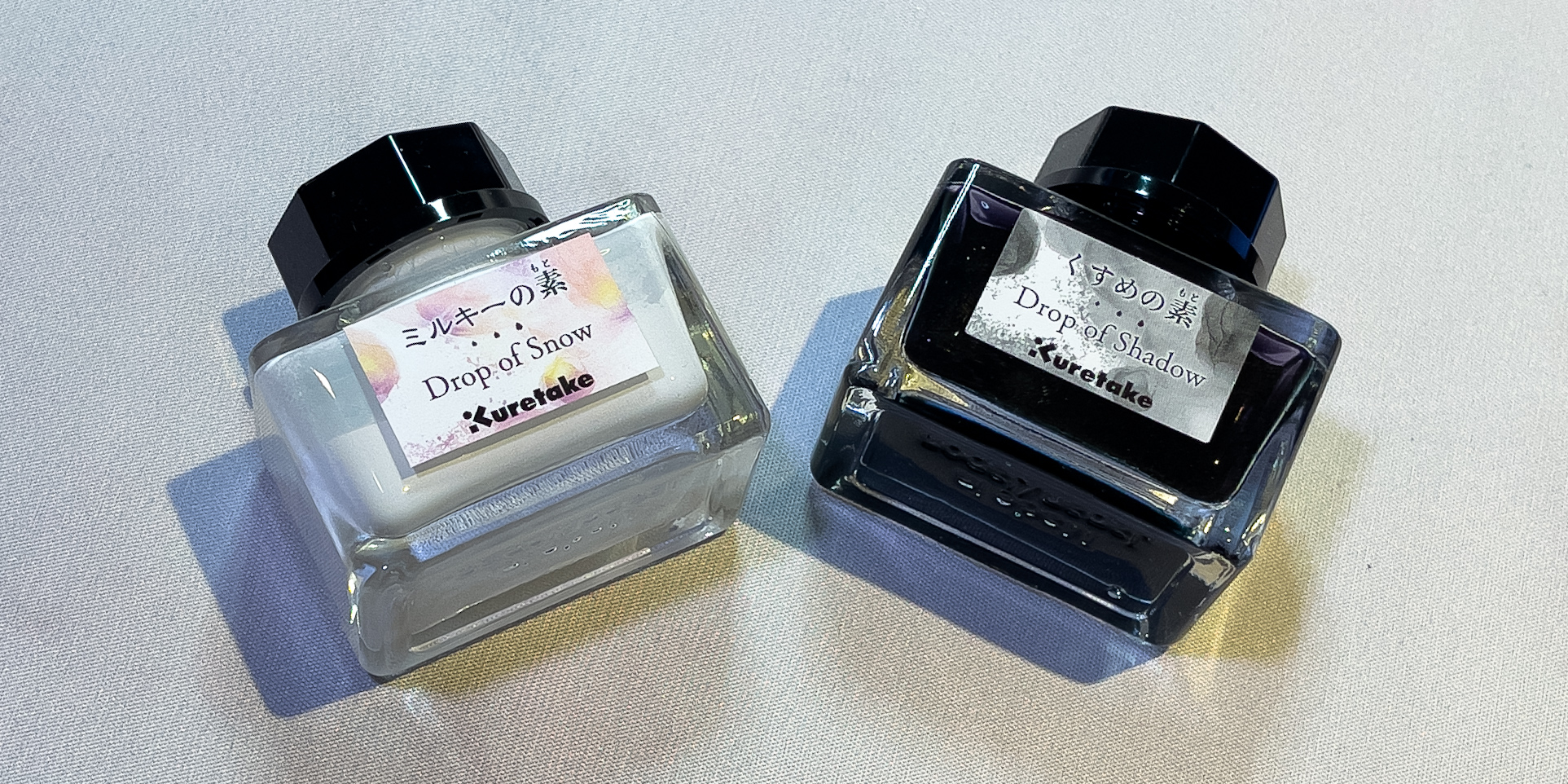
Kuretake’s “Drops of” Additives
Japanese ink brand Kuretake makes a number of ink additives, including the Drop of Thinner and Drop of Shimmer mentioned above. However, they also have a couple of other very nifty products I haven’t seen in any other brand’s product range:
Drop of Shadow
This is a grey-coloured medium that mutes and dulls ink colours to create darker, cloudier, richer shades.
Available from Amazon.
Drop of Snow
This is a white, milky medium that you can use to transform bright colours into lighter pastel shades; it can also be used by itself as a white ink.
Available from Amazon.
Here’s an example of Pilot Iroshizuku’s Fuyu-gaki ink with several different additives:
- Top left L-R: Fuyu-gaki plus Van Dieman’s Diluter at ratios of 5:1 and 1:1
- Top right L-R: Fuyu-gaki plus Kuretake Drop of Snow at ratios of 1:10, 1:5 and 1:1
- Bottom L-R: Fuyu-gaki plus Kuretake Drop of Shadow at ratios of 1:10, 1:5 and 1:1

What About Sheen Additives?
In short: they’re not a thing.
Sometimes people talk about sheen like it’s something an ink maker can just choose to add or remove when developing an ink.
However, sheen is an inherent property of the dyes used to colour the ink, and it’s caused when certain dyes dry on the surface of the paper without being absorbed – so you could also say that they’re an inherent property of the ink dyes and their interaction with a specific paper.
All of this means that you can’t just add an external additive to an ink to make it sheen, unfortunately.
And there we have it! Hopefully this helps clarify any confusion around different ink additives. If you have any questions please feel free to drop them in the comments – if I don’t know the answer I’ll do the research and get back to you.
Please note: Amazon links in this post are affiliate links; if you buy anything using my link, I will earn a small commission at no cost to you.